
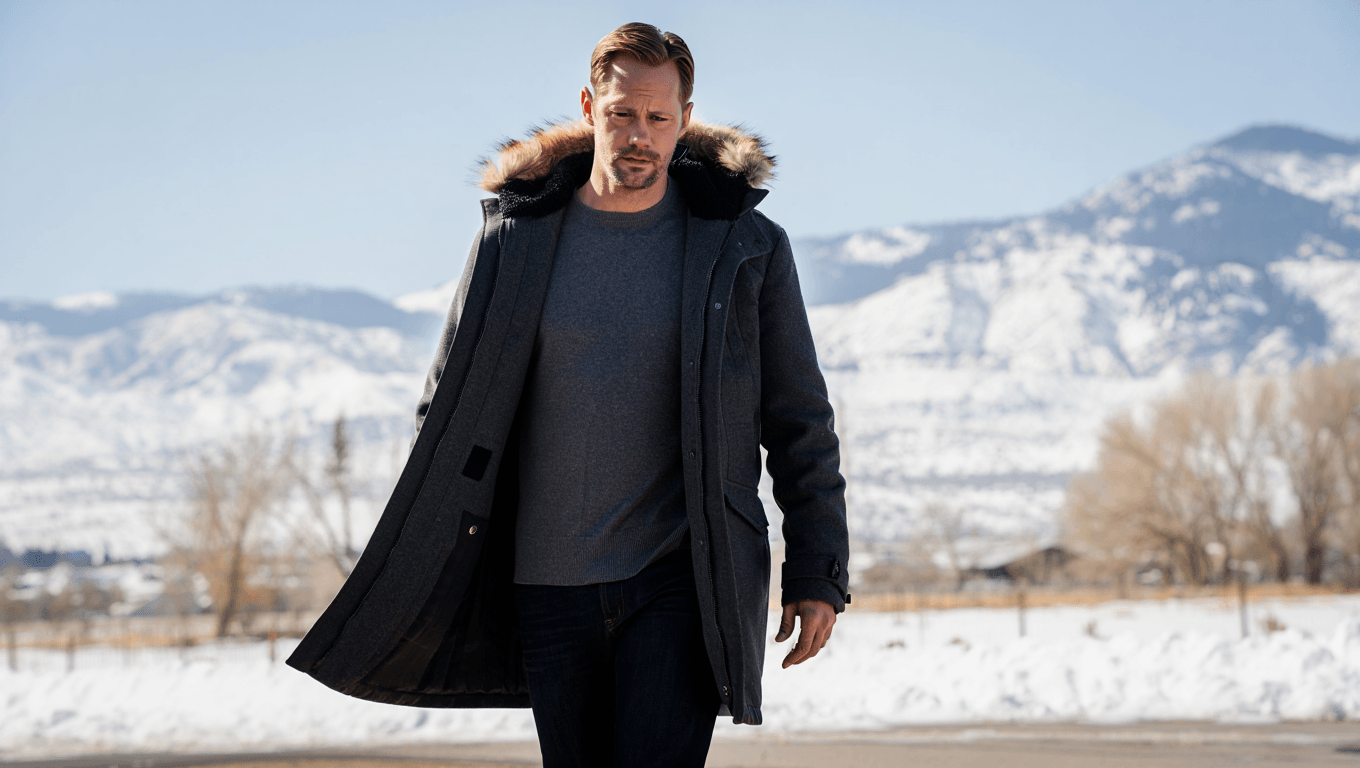
Alexander Skarsgård says portraying his role in Wicker presented unexpected difficulties. The film had its debut this year at the Sundance Film Festival in Park City, Utah.
The story centers on a fisherwoman who commissions a craftsman to weave her a husband out of a basketmaker’s materials. Skarsgård plays that man constructed from twigs and reeds.
He didn’t find the visual design the hard part; rather, he struggled with embodying an almost purely benevolent character.
At a Saturday question-and-answer session — which Entertainment Weekly attended — Skarsgård explained that the script initially made him nervous because he’s usually pulled toward characters who carry inner conflict and darkness. Stepping into the shoes of a kind-hearted, morally upright, sweet-natured figure felt intimidating to him. He admitted he wasn’t comfortable with that kind of role and that it required him to stretch as an actor because he had little personal reference to draw on.
Skarsgård is better known for grittier, more troubled parts. His résumé includes Eric Northman on True Blood, an abusive spouse in Big Little Lies, a cold tech billionaire on Succession, and a vengeance-driven figure in The Northman. Even so, he was eager to try something different.
He praised Wicker’s screenplay, calling it brilliant. He described the film as fable-like and allegorical — a commentary on society that avoids being preachy or heavy-handed. He also found it tender and funny, and he was intrigued by the challenge of bringing the character to life.
A major practical obstacle was how the character looked and the constraint that imposed on his facial performance. He said the role required a kind of stiffness that came easily — and an awkwardness that wasn’t hard to access either — but they also experimented with how the figure would change over time. Watching the finished film, Skarsgård noticed how sound design helped convey that progression: the wicker initially creaks and feels freshly made, then the husband gradually loosens up as he grows more comfortable.
Because pieces of wicker were affixed to his face, Skarsgård had to work harder to convey emotion without relying on typical facial movement. During very vulnerable exchanges with Colman, for example, her face could transform dramatically on camera while his had to remain relatively still.
He recalled moments of feeling as if “nothing happened” on his face, and that he had to intentionally amplify subtle gestures until they registered. That ran counter to his instincts as an actor and left him feeling self-conscious, but he trusted the filmmakers when they suggested tiny adjustments — like subtle eyebrow movements — to get the effect they wanted.

Hi, I’m Emily, a passionate and dedicated member of the Sherburne County Citizen team. With a keen eye for detail and a love for writing, I ensure that the latest celebrity news, major economic trends, and helpful tips for your home are presented in the most engaging and informative way possible. Fun fact: During a particularly exciting news story, I once managed to finish an article in record time, fueled solely by copious amounts of coffee and pure adrenaline!
